
by Marla Koss
ACTION ITEM! Please read this UCANR article, and pass on to anyone you know with a fig tree!
One Saturday morning in June 2025, members of Farm2Market’s orchard crew were arriving and assembling their tools when I heard happy shouts of “Mae!” through the trees. And suddenly our friend and mentor, longtime fruit tree professional Mae Clark, was heading towards us on the farm’s main path.
“What’s up, Mae?” I was prepared for some sort of impish reply, but her face darkened.
“Black Fig Fly – “ she said, shaking her head. There was real upset and urgency in her voice. This was a new pest that her clients and fellow members at California Rare Fruit Growers (Golden Gate Chapter) were freaking out about. This new pest had traveled up from Southern California and was poised to ruin everybody’s backyard fig crops with a vengeance.
We made our way to the orchard’s 6 fig trees. And there it was, mulch blackened by so many fallen figs under the orchard’s biggest fig tree, a massive, far-reaching Mission Fig. Mae made the positive identification and the rakes came out in numbers. If Mae had not made the trip from her home in Richmond that morning to warn us of this new pest, we could have sustained a lot of damage. Yes, we would have cleaned up under the tree, but wouldn’t have realized the potential harm a few dozen fallen figs here and there could have eventually done. As it is, we are monitoring that tree and have found no infestation yet, though so far three of the orchard’s other fig trees have been hit this year. It may just be that the Mission fig / BFF cycle is later than those of the farm’s other trees.
We urge you to begin checking your fig tree(s) and pick up any figs that have dropped to the ground around and under them. The fallen figs are usually small and dry out quickly – often after the Black Fig Fly maggots inside have crawled out into your soil to pupate. Dispose of fallen figs in the city compost (green container) – NOT in your own backyard compost.
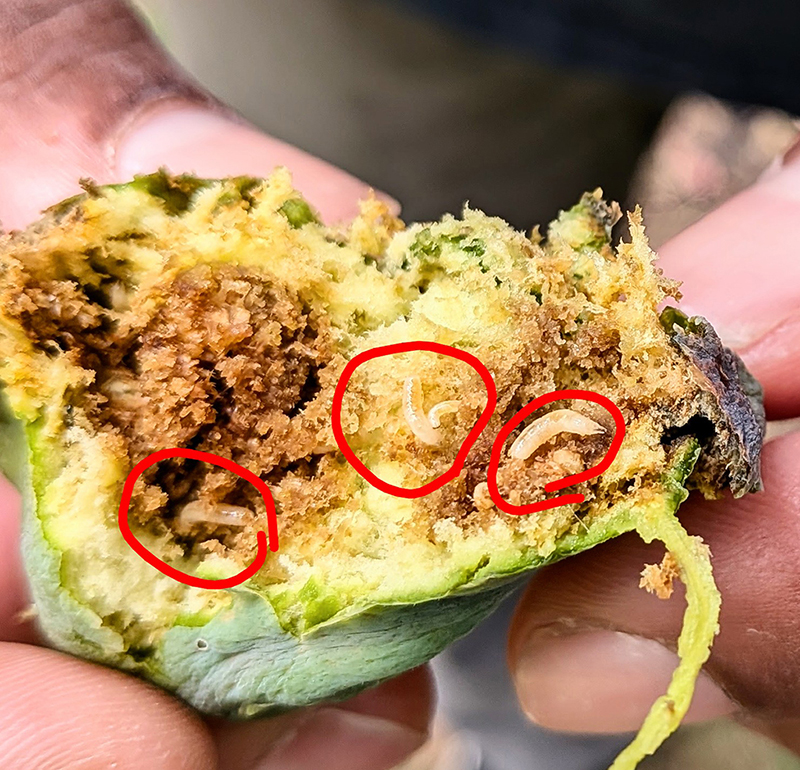
The above photo shows maggots in a White Genoa fig collected at Farm2Market on June 20th. The fig was still on the tree, and about to fall. Broken open, there were at least half-a-dozen maggots wiggling inside. I have circled three areas where you can see maggots: the circle on the left has one maggot; the middle circle has one large maggot plus one small one; the right-hand circle has one maggot (by the way, maggot = larva).
Make a habit of picking up fallen figs daily. Depending on color, some varieties of fig will darken and show reddish patches; those will most likely be ready to fall soon. Grab them if you see them on the tree. Some trees, like the White Genoa and other figs that stay greenish yellow when ripe, may not show a color change when infested. You’ll only notice once they’ve fallen.
If you don’t see any fallen figs, keep checking – your tree is most likely going to get hit sooner or later. By picking up and disposing of fallen figs, not only are you going to help stop the cycle of maggot > pupa > fly with your own fig tree, you will be helping keep the flies from spreading throughout your neighborhood (Alameda is full of backyard fig trees).
Right now – anecdotally – the best way to fight the BFF may be McPhail Traps and torula yeast tablets. One place to order them without getting scalped is Harmony Farm Supply; the traps may say they are for olive fruit flies, but these also work for Black fig flies. You can also D.I.Y. traps out of large plastic soft drink bottles; buy the torula yeast pellets separately and read up on D.I.Y. traps online. You may catch a few other types of fly in the trap, but it’s been touted as an effective way to catch female Black Fig Flies before they go ruining your whole crop.