
On Saturday, June 13, 2026, Ploughshares Nursery General Manager Jordan Taylor gave a comprehensive talk on the ins and outs of caring for our backyard tomatoes throughout the season. Though most everybody has some experience growing tomatoes, access to a nursery professional like Jordan helps fill in the various knowledge gaps we all have (plus, Jordan picked up her tomato smarts in New Jersey, where tomatoes don’t get any juicier and more delicious in mid-summer).
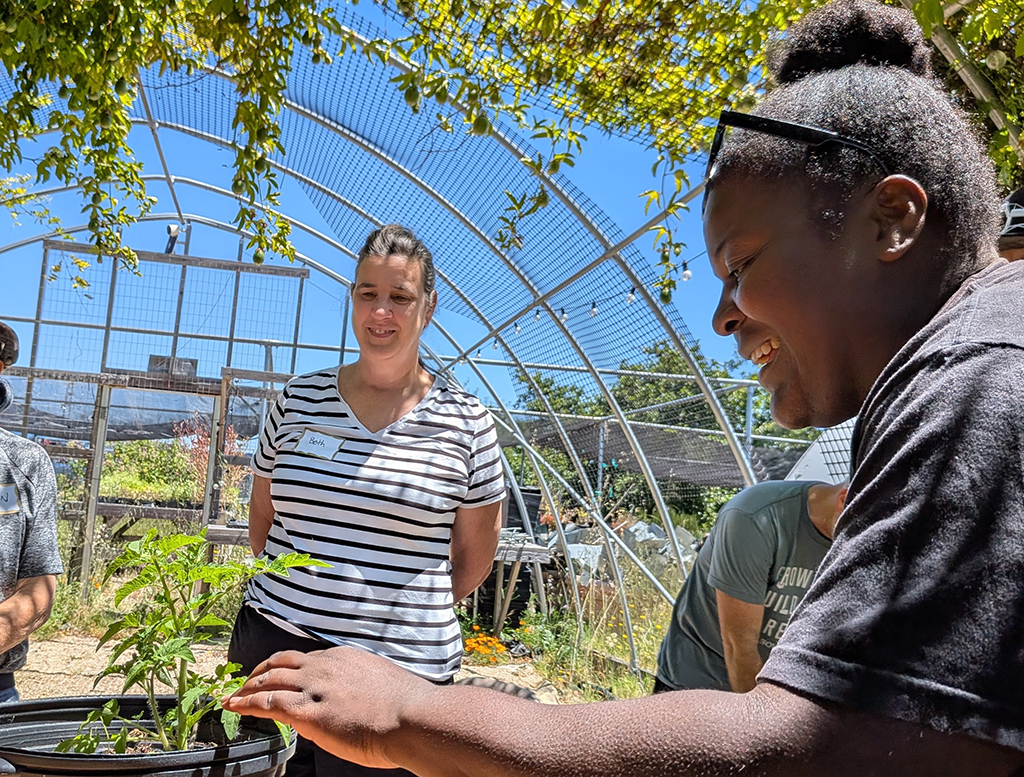
Some wisdom from Jordan:
It’s well-known that tomato plants – and other plants of the nightshade family (tomatoes, eggplant, peppers and potatoes) – can take advantage of deep planting to form new roots. It’s actually the numerous tiny hairs all up and down the main stem of the plant that enable that new root production, if the plant’s stem is buried either vertically or horizontally in a trench method.
Feeding a tomato plant should be done throughout the growing/fruiting season. Begin with a tomato & vegetable fertilizer with a balanced NPK (Nitrogen/Phosphorus/Potassium) ratio. Mix the proper amount (according to package directions) in with the dirt in the planting hole. Feed the plant weekly with this formula until blossoms appear. At this point switch to a lower-nitrogen/higher-phosphorus & potassium formula to support better blossoming and fruit production. Use granular fertilizer for plants in the ground, liquid fertilizer for those in containers.
For bushy (determinate) tomato varieties, pinch out some of the suckers that form at the junction between two branches. This allows free movement of air through the plant and sunlight reaching into the plant’s middle. Pinched-off suckers can be sprouted into new plants when dipped in Rootone and planted directly in soil.
For vining (indeterminate) tomato varieties – which tend to sprawl or wander through the rest of the garden if left to themselves – decide after planting how many vines you want to keep: one vine for vertical cordoning of the plant on a trellis; three if the plant will be caged or staked. Narrowing the number of vines forces the plant’s energy into each vine for better fruiting. This is especially true for cherry tomatoes.
To keep pests and diseases at bay:
- Keep tomato plant leaves from touching the ground, to avoid contamination from soil-borne diseases (blights, wilts, etc.).
- Plant basil and marigolds to ward off hornworms.
- Attract beneficial insects by including borage, parsley and/or dill.
Be careful with your watering:
- Inconsistent watering can cause Blossom End Rot (BER) – especially on paste-type tomatoes. Some tomatoes split when the outside skin is done growing, but too much water causes the inside to keep expanding.
- If tomato plants wilt a bit during the day, they don’t necessarily need more water. The real indication of insufficient watering is, if the plants are still wilted the next morning.