
Fig tree owners, you’ve had a disturbing year, thanks to the Black Fig Fly (BFF), if nothing else. Maybe last year you saw dropped figs and thought it was just the cold summer weather, but by now you should have noticed all the dropped figs and wondered what was up. In ABG’s last newsletter we advised that you pick up dropped figs daily and throw them in the city compost (green) bin, not in your own. Waste Management heats green bin yard waste to the point that no pests or diseases can survive; your own compost bin most likely will not. The reason for picking these fallen figs up is, though most of the maggots that are part of this pest’s cycle of life have already dropped into the soil by the time the fig hits the ground (they do these death-defying, parachuteless drops straight from a hole they chew in the side of a fig on the tree and bomb’s away!), a few of the figs on the ground may still have a maggot or two inside. In June, I picked up a hard little fig under the tree and saw a maggot halfway out the hole. Hey, Little Buddy, it’s the green bin for you!
So this pest (Silba adipata) seems to have made its way here from its source in the Mediterranean region via infested fig wood, bypassing necessary import screening. And quickly took to the “Mediterranean” climate of California, and – bonus! – a region free of natural predators. A region full of backyard fig trees that provided awesome fruit needing little to no attention from its owners.
The BFF Life Cycle
In spring, female Black Fig Flies deposit their eggs into the ostioles (openings on the end farthest from the stem) of unripe figs; the eggs develop into maggots (larvae); and the maggots eat their way out of the fig while it’s still on the tree. If there is mulch, bare soil or garden vegetation below, they burrow in and pupate in preparation for leaving the ground as mature flies, to start the cycle all over again. (In warmer climates, BFF’s can have as many as 4 cycles in a season.) BFF’s can’t be sprayed for; those little maggots are safe inside the fig. Nor is there any effective soil drench for home gardeners to kill the pupae in the ground.
For Full Protection, You Could Try This
Want to bypass all the work of fending off this nuisance fly as well as squirrels and birds? It’s a zip-up mesh bag sold in several sizes. It lets in light, air, and water, and keeps every sort of pest away from the tree. Some backyard fig growers with smaller trees have had great success. Next spring I will fit one on a smaller (1 of 3) fig trees in my backyard on Pearl Street to see how it does, and report back.
Trapping
In the last ABG newsletter we mentioned using traps. We have been experimenting with the McPhail trap and various lures to place inside, with varying degrees of success. A friend of ABG recently told us that he had trouble finding any McPhail traps online, but hopefully by next spring the supply will increase (you can also make your own version of the McPhail trap at home; just ask Google). Our trapping has taken place at my yard on Pearl Street, another yard mid-town, and at Farm2Market, in their sizable orchard. McPhail traps using torula yeast tablets dissolved in tap water caught plenty of flies of many sorts – and thankfully no honeybees. McPhail traps used at Farm2Market used Hexanol lures and granular ammonium sulfate in water – which did catch BFF’s and little else. Some growers also add a bit of fig latex to the water to add to the success rate. (Note on the Hexanol lures: they are sealed in little plastic bags and are supposed to remain in them, but their scent is so strong that we advise you to wear a KN-95 mask when opening the shipping box and attaching them to the inside dome of the McPhail trap; that stuff gave me a pretty bad headache.) But whatever you do, please do not use sticky boards; though there’s no reason for a bee to spend time near your fig tree, they can get caught on the sticky board trap and that’s a tragedy.
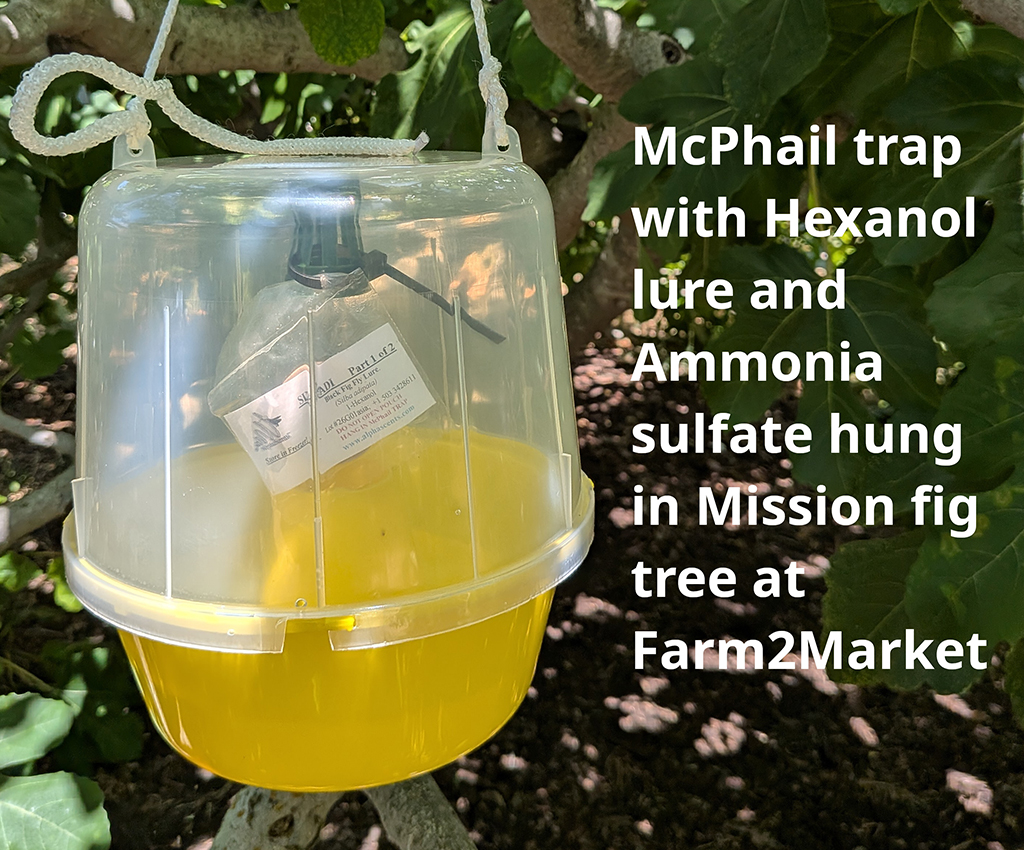
McPhail trap at Farm2Market orchard
Controlling is Key
To date, there is no 100% effective method for stopping the BFF cycle and its attack on our entire community of fig trees. One recommended way to help control them is to lay water-permeable landscape fabric down under the tree, spreading it out as far as the tree’s drip line and holding it down with staples, bricks or stones around the edge. Even better would be to remove the top several inches (up to 4 inches) of soil (and/or any mulch that was there) before laying down the landscape fabric. Leaving this landscape fabric bare might be unsightly, but will allow you to sweep up any fallen figs you see next year, and keep maggots from burrowing into the ground underneath.
But the foregoing does not mean you are fully protected, not at all! All the local fig trees that are left unattended will be active sources of the pest, so that even if you cover your soil to stop the BFF pupa-to-fly part of the cycle under your own fig tree, BFF’s can just as easily fly over and target your figs. It’s how they got there in the first place. You may cut down on the amount of crop loss, but there’s another one or two tasks to do. In the following newsletter posts on the BFF, I’ll be sharing with you what a few of us ABG volunteers are doing to protect our figs, as well as the results of experimentation in the fig section of Farm2Market’s orchard. It involves taping the ostioles closed on figs as small as 15 mm (chickpea-sized). One longtime poster on Ourfigs.com experimented with different types of tape to see which worked best to stay on and protect figs throughout the season. It’s a fascinating read!
We recommend using at least two methods of control, and this winter we (and the orchard at Farm2Market) will be
- Removing soil from underneath our fig trees (and leaving that infested mulch/soil under a tarp to cook in the sun when the weather heats up, to kill any pupae).
- Laying down a barrier (permeable landscape fabric).
- Taping the ostioles of a certain number of baby figs shut, and monitoring them to make sure they stay on (the blue tape is really easy to spot, especially in dense foliage).
- Trying a protective mesh cover over one or more of the smaller trees (WITH landscape cover also laid down under the tree).
- Trapping using either the torula yeast or Hexanol + Ammonia sulfate in McPhail traps.
So the easy-care common fig tree has become a worry and a bother, much like the backyard apple tree with its threats of Codling Moth. But take heart – in perusing the OurFigs.com website (I became a member to keep up on BFF news), I discovered that some folks have to deal with Fig Mite and the Fig Mosaic Virus they carry.
Miscellaneous points
If you own a fig tree and don’t want to bother with any BFF protection measures, consider removing it. As much as the tree might otherwise contribute to the environment as a carbon sink, wildlife sanctuary and/or air filter and give shade, it will be nourishing clouds of BFF’s that will continue to infest other trees.
The BFF will go for every fig tree it can find, but seems to especially target the Black Mission variety. If you have a Black Mission fig tree, you may not get any edible figs off of it this year (or any year it’s not protected). The Mission fig tree at Farm2Market (a monster of a tree), has been so badly infested that it looks like there won’t be a single fig left on the tree safe to eat (Farm2Market plans to remove mulch and soil underneath it, lay down landscape fabric and put up the McPhail traps in the spring).
BFF’s generally like to oviposit into unripe figs, of which there are plenty early in the season. But a late summer generation of BFF’s often have to settle for figs on their way to ripening. So, say you spy the fattest, most delicious-looking fig on the tree, pick it, cut it open, and find the whole inside is wiggling (which happened to me just yesterday). Cutting each one open before taking a bite is a good idea; you may be staring into the most jewel-like, clean, ripe fig interior, or a wiggling BFF nursery (the maggots won’t hurt you if you eat them, but how disgusting). Just FYI.